



Introduction: Why Another Linear Equation?
If you’ve spent any time in an Algebra I classroom, you’ve likely had the Slope-Intercept Form () drilled into your brain. It’s the “Old Reliable” of mathematics. However, as you progress into higher-level algebra, geometry, and calculus, you quickly realize that you aren’t always given the y-intercept on a silver platter.
Sometimes, all you have is a random point on a graph and the “lean” or “slant” of the line. This is where the Point-Slope Form shines. It is arguably the most versatile and “human-friendly” way to write the equation of a line because it requires the least amount of preliminary calculation.
In this guide, we’ll break down what the point-slope form is, why it works, and how to master it in seconds.
What is Point-Slope Form?
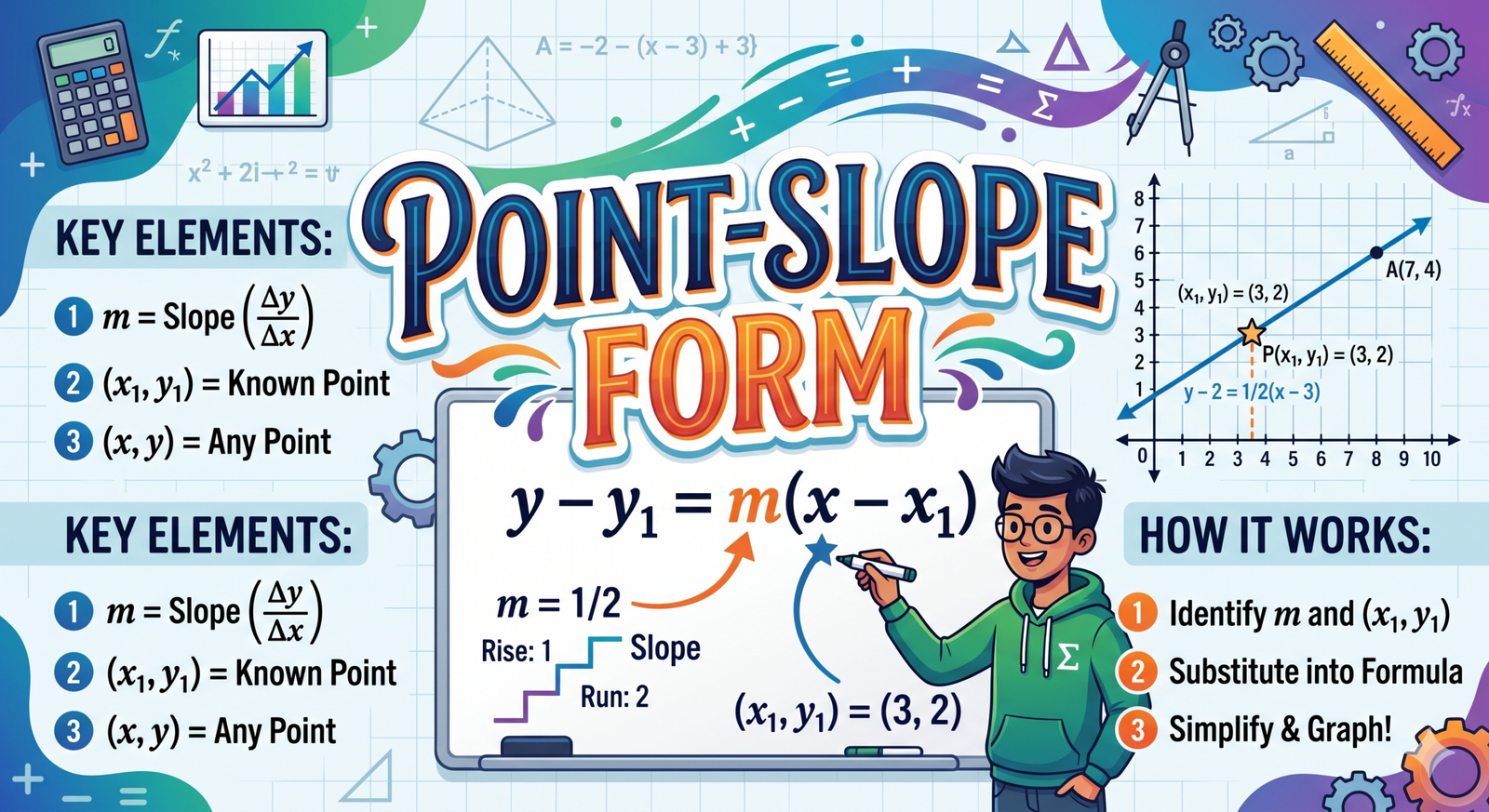
The point-slope form is a specific arrangement of a linear equation that uses the coordinates of a single point on the line and the slope of that line.
The Formula
The standard mathematical representation is:
Here is what those variables actually mean:
-
: The slope of the line (the “rise over run”).
-
: The coordinates of a known point on the line.
-
and : The variables that remain in the final equation to represent any generic point on the line.
The Logic Behind the Formula
If you look closely, this formula is just a rearranged version of the slope formula itself. Remember that:
If you multiply both sides by , you get the point-slope form. Essentially, this equation is just saying: “The ratio of the vertical change to the horizontal change is always constant (the slope).”
How to Use Point-Slope Form (Step-by-Step)
Using this form is often faster than slope-intercept because it eliminates the need to solve for (the y-intercept) immediately. Follow these three steps:
1. Identify Your Givens
You need two pieces of information: a point and a slope ().
-
Example: Let’s say we have a slope of 3 and the line passes through the point (4, -2).
2. Plug the Values into the Formula
Substitute , , and into the equation .
-
Substitution:
3. Simplify (Watch the Signs!)
Double negatives are the most common pitfall for students.
-
Simplified:
At this point, you are technically done! This is a valid equation for a line. However, most teachers will ask you to convert it into Slope-Intercept Form ().
4. Optional: Convert to Slope-Intercept Form
To do this, distribute the slope and isolate :
-
-
Subtract 2 from both sides:
Real-World Scenarios and Examples
Let’s look at a few common ways you’ll encounter this keyword in your homework or exams.
Scenario A: Given Two Points
What if you aren’t given the slope?
-
Points: and
-
Find the slope first:
-
Pick a point: Let’s use .
-
Write the equation:
Scenario B: Parallel and Perpendicular Lines
Geometry loves point-slope form.
-
Problem: Write an equation for a line passing through that is parallel to .
-
The Trick: Parallel lines have the same slope. So, .
-
The Result:
Point-Slope vs. Slope-Intercept: Which is Better?
While is great for quick graphing (since you start at the y-intercept), point-slope form is superior in several areas:
In the real world, data points rarely fall perfectly on the y-axis (where ). If you’re tracking the growth of a business or the speed of a car, you’re more likely to have a data point from “Day 4” or “Minute 10.” Point-slope form handles this “messy” real-world data with ease.
Common Mistakes to Avoid
-
Mixing up X and Y: Always remember that goes with the on the left, and goes inside the parentheses with the .
-
The Sign Flip: The formula uses subtraction. If your point is , the equation becomes , which simplifies to plus signs: .
-
Forgetting to Distribute: If you are converting to another form, don’t forget to multiply the slope by both terms inside the parentheses.
Final Thoughts
The point-slope form is more than just a math requirement; it is a conceptual bridge. It connects the definition of slope directly to the visual representation of a line. By mastering , you aren’t just memorizing a formula—you’re learning how to describe the path of a line from any starting position in the coordinate plane.
read also : CoreWeave’s Exponential Leap: Surging Stocks, Multi-Billion Dollar Deals, and the Race to 6GW
Why should I use Point-Slope Form instead of Slope-Intercept Form?
The biggest advantage is speed. If you are given a point like $(5, -2)$ and a slope of $3$, you can plug them directly into the formula ($y + 2 = 3(x – 5)$) and you are finished. In Slope-Intercept Form ($y = mx + b$), you would have to perform extra algebraic steps to solve for $b$ (the y-intercept) before you could even write the final equation.
Can I convert Point-Slope Form into other forms?
Yes, and it’s very simple. To convert to Slope-Intercept Form ($y = mx + b$), just distribute the slope ($m$) and isolate $y$.
Example: $y – 3 = 2(x – 1)$ becomes $y – 3 = 2x – 2$, which simplifies to $y = 2x + 1$.
To convert to Standard Form ($Ax + By = C$), move the $x$ and $y$ terms to one side and the constant to the other.
What if I am given two points but no slope?
You can still use Point-Slope Form! First, calculate the slope ($m$) using the slope formula:
$$m = \frac{y_2 – y_1}{x_2 – x_1}$$
Once you have the slope, pick either of the two points to be your $(x_1, y_1)$ and plug them into the Point-Slope formula. The result will be the same regardless of which point you choose.
How do I handle negative numbers in the formula?
This is the most common place where errors occur. The formula has built-in subtraction: $y – y_1$. If your point has a negative coordinate, such as $(-4, -7)$, the “minus a negative” becomes a plus.Example: $y – (-7) = m(x – (-4))$ becomes $y + 7 = m(x + 4)$. Always be careful to flip the sign when plugging in negative coordinates.
Is the Point-Slope Form used in real-world applications?
Absolutely. It is the go-to tool for Linear Regression in data science and trend analysis. When a scientist finds a “Line of Best Fit” for a set of data points, they often identify the slope (the rate of change) and use a specific data point to anchor the equation. It’s also used in Calculus to find the equation of a tangent line to a curve at a specific point.
