



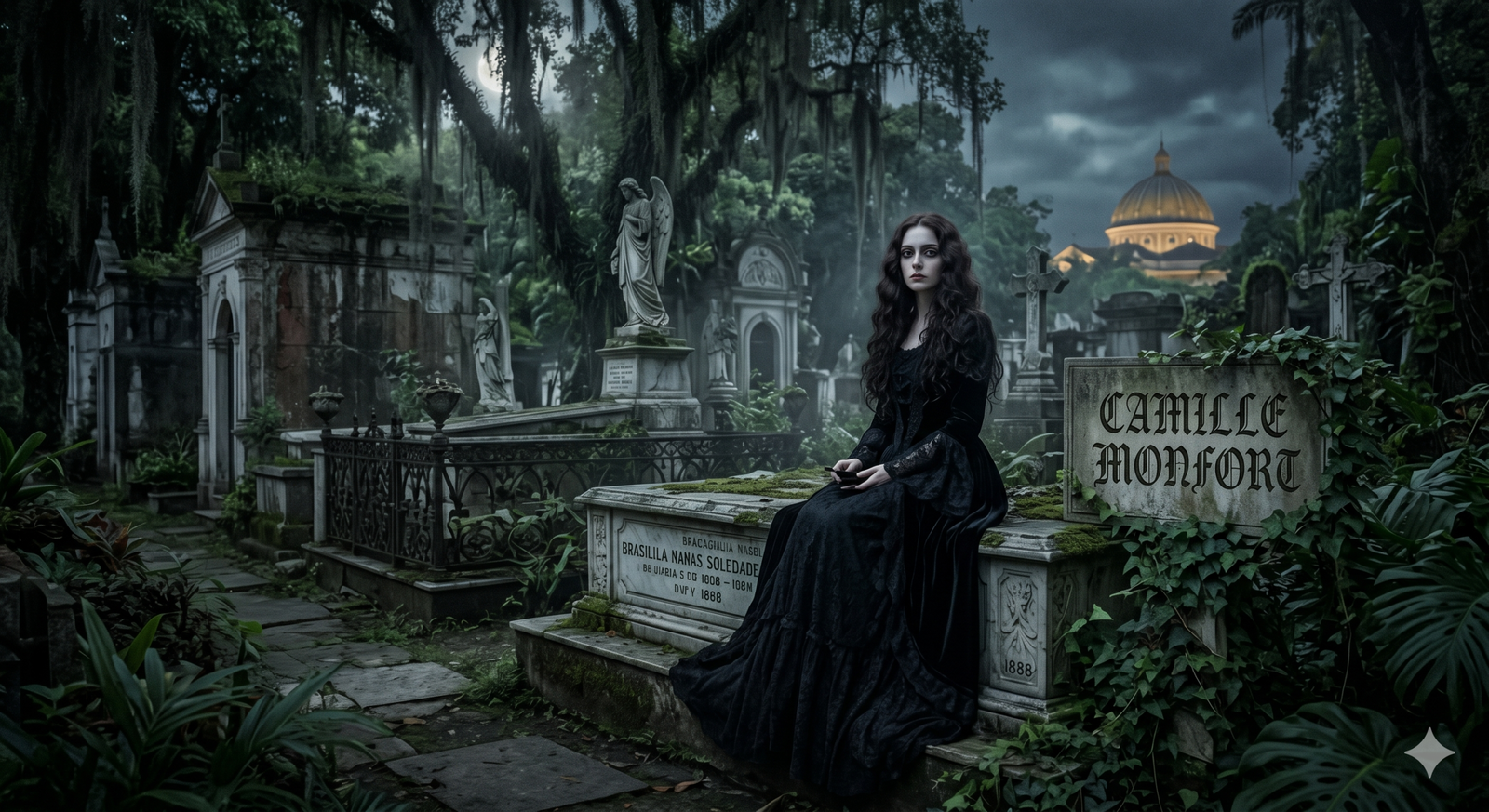
The humid air of late 19th-century Belém, Brazil, was thick with the scent of jasmine, the bustling energy of the rubber boom, and—if the local legends are to be believed—the faint, metallic tang of blood. In the heart of the Amazon, during an era of unprecedented wealth and European influence, one name emerged to haunt the social galas and the dark alleys alike: Camille Monfort.
Known as the “Vampire of Belém,” Camille Monfort occupies that thin, shadowy line between historical fact and gothic folklore. Her story is a captivating tapestry of elegance, tragedy, and the supernatural, making her one of the most enduring urban legends in Brazilian history.
The Arrival of a French Muse
The story begins with the arrival of a beautiful young woman from France. At the height of the “Belle Époque” in the Amazon, Belém was known as the “Paris of the North.” The city was flush with “black gold” (rubber money), and the wealthy elite sought to replicate European high society. This meant importing everything from architecture and fashion to opera singers and performers.
Camille Monfort was reportedly an opera singer—or perhaps a socialite—of striking beauty. Descriptions of her often highlight her pale, porcelain skin, her deep, melancholic eyes, and a wardrobe of flowing black lace that stood out against the vibrant tropical backdrop. She was a regular presence at the Theatro da Paz, the city’s grand neoclassical jewel. However, it wasn’t just her voice or her beauty that caught the public’s attention; it was her nocturnal habits.
From Socialite to Supernatural
In a city where the elite were obsessed with status, Camille’s behavior began to trigger whispers. She was rarely seen during the day, emerging only as the sun dipped below the Amazonian horizon. She was often spotted walking alone through the streets or sitting in the shadowy corners of the theater.
The rumors took a darker turn when stories of “mysterious illnesses” among the local youth began to circulate. Gossip suggested that those who spent time in Camille’s company returned pale, lethargic, and drained of energy. The local press, always eager for a sensation, fueled the fire. People claimed she had been seen in the cemeteries of Belém, communicating with the dead or performing strange rituals under the moonlight.
The nickname “The Vampire” was not just a metaphor for her captivating, soul-draining presence; it became a literal accusation.
The Gothic Mystery of the Cemetery
Every great vampire legend requires a resting place, and Camille’s story is inextricably linked to the Cemitério da Soledade. Built in 1850, this cemetery is a masterpiece of funerary art, filled with moss-covered angels and crumbling marble mausoleums.
According to legend, Camille died young—some say of the plague, others suggest a broken heart or a more “supernatural” transition. Her grave at Soledade became a focal point for the myth. Visitors claimed to see a woman in a white or black dress wandering the aisles of the cemetery at night. The atmosphere of Soledade, with its heavy humidity and overgrown vegetation, provided the perfect stage for such sightings.
Even today, the image of a pale French woman sitting atop a Victorian tombstone remains a staple of Belém’s ghost tours.
Separating Fact from Folklore
When we peel back the layers of the legend, what do we actually find? Historically, there is very little concrete evidence of a specific “Camille Monfort” who fits every detail of the myth. However, the story is deeply rooted in the socio-cultural reality of 19th-century Belém.
-
The Foreign “Other”: Camille represents the fascination and fear of the European influence that was flooding the city. She was the “outsider”—beautiful but potentially dangerous.
-
The Yellow Fever Epidemics: During this period, Belém was frequently hit by outbreaks of yellow fever and cholera. These diseases left victims pale, weak, and “drained,” mirroring the symptoms of a vampire’s kiss. It is likely that the “vampire” was a personification of the sudden, inexplicable deaths caused by disease.
-
The Romantic Movement: This was the era of Byron and Poe. Gothic literature was at its peak, and the imagery of the “femme fatale” or the “undead lover” was a popular trope that the residents of Belém applied to local mysteries.
The Modern Legacy
In the digital age, Camille Monfort has seen a massive resurgence. AI-generated images and viral social media posts have brought her story to a global audience. While some of these “historical photos” are modern fabrications, they capture the essence of what Camille represents: the timeless allure of the gothic.
For the people of Belém, she remains a point of pride and a mystery that keeps the city’s history alive. She is a reminder of a time when the Amazon was the center of the world’s wealth and when the line between the rainforest and the ballroom was dangerously thin.
Conclusion
Whether Camille Monfort was a real woman whose life was misunderstood or a complete invention of a superstitious public, she has achieved a form of immortality that even a vampire would envy. She is the ghost in the theater, the shadow in the cemetery, and the eternal muse of the Amazonian Belle Époque.
As you walk through the streets of Belém today, past the fading grandeur of the rubber mansions, it’s easy to look into the shadows and wonder if a pale woman in black lace is watching from a balcony, waiting for the sun to set.
read also : Master the Point-Slope Form: The Linear Equation’s Secret Weapon
Was Camille Monfort a real person?
There is no historical record of a famous French opera singer named Camille Monfort arriving in Belém in 1896. While there is a tomb in the Cemitério da Soledade inscribed with the name “Camila María Monfort,” historians and researchers generally agree that the supernatural lore surrounding her was popularized by the fictional works of writer Bosco Chancen.
Why was she accused of being a vampire?
In the legend, her vampirism was blamed on an “attack” she allegedly suffered while living in London. Her pale skin, solitary night walks along the Guajará River in black gowns, and reports of fans fainting at her concerts (likely due to tight corsets and heat) fueled the rumors among the superstitious elite of the time.
Does her grave actually exist in Belém?
Yes. There is a neoclassical mausoleum in the Cemitério da Soledade (Cemetery of Solitude) in Belém that is associated with her. It is often covered in moss and shaded by a large mango tree, adding to the eerie atmosphere. The inscription reads: “Here lies Camila María Monfort (1869-1896) – The voice that captivated the world.”
What is the “Bolonha Mansion” connection?
Legend says Camille was the lover of Francisco Bolonha, a wealthy architect who reportedly brought her from Europe. Stories claim he would bathe her in expensive imported champagne in his mansion. While Francisco Bolonha was a real and prominent figure in Belém’s history, his romantic connection to a “vampire” is part of the myth rather than documented history.
How did she “die” in the story?
In the narrative, Camille Monfort died in late 1896 during a devastating cholera outbreak in Belém. However, true to vampire lore, believers in the legend claim she faked her death to escape the growing suspicion of her neighbors and that she continues to wander the world, still as young as she was in 1896.
