



I once stood in a small kitchen in London, staring at a rental oven with the kind of confusion usually reserved for advanced calculus. The recipe from my grandmother’s dog-eared Midwestern cookbook called for a “steady 350 degrees.” The dial on the oven, however, topped out at 250. For a frantic five minutes, I genuinely thought I had discovered a British conspiracy to prevent the baking of cookies.
Then, the realization hit: Celsius.
That moment is a rite of passage for anyone traveling, moving, or even just browsing international recipes online. The search for “f to c” is more than just a mathematical query; it’s a plea for cultural translation. We live in a world divided by two very different ways of feeling the air around us, and bridging that gap requires more than just a calculator—it requires a bit of mental gymnastics and a sense of humor.
Why We Are Like This
If you grew up in the United States, Fahrenheit is your native tongue. It is a system built on the human experience. To a Fahrenheit user, 0°F is “really stinking cold,” and 100°F is “really stinking hot.” It’s a 0-to-100 scale of human misery and comfort.
On the flip side, the rest of the world (and the entire scientific community) speaks Celsius. It’s a system built on the logic of water. At 0°C, water freezes. At 100°C, it boils. It’s clean, it’s metric, and it makes perfect sense to anyone who isn’t currently trying to figure out if they need a light jacket or a heavy coat based on a number like 62.
The friction between these two systems is why “f to c” is one of the most persistent searches on the internet. We aren’t just looking for a number; we are trying to map our physical reality onto a different grid.
The “Napkin Math” We Actually Use
Let’s be honest: nobody is standing in the middle of a terminal at Heathrow or looking at a European weather app and doing the official formula in their head. You know the one: $C = (F – 32) \times 5/9$.
Unless you’re a math teacher or a savant, that “5/9” fraction is a mood killer. In the real world, we use “human math.” If you need to convert F to C on the fly, here is the secret handshake:
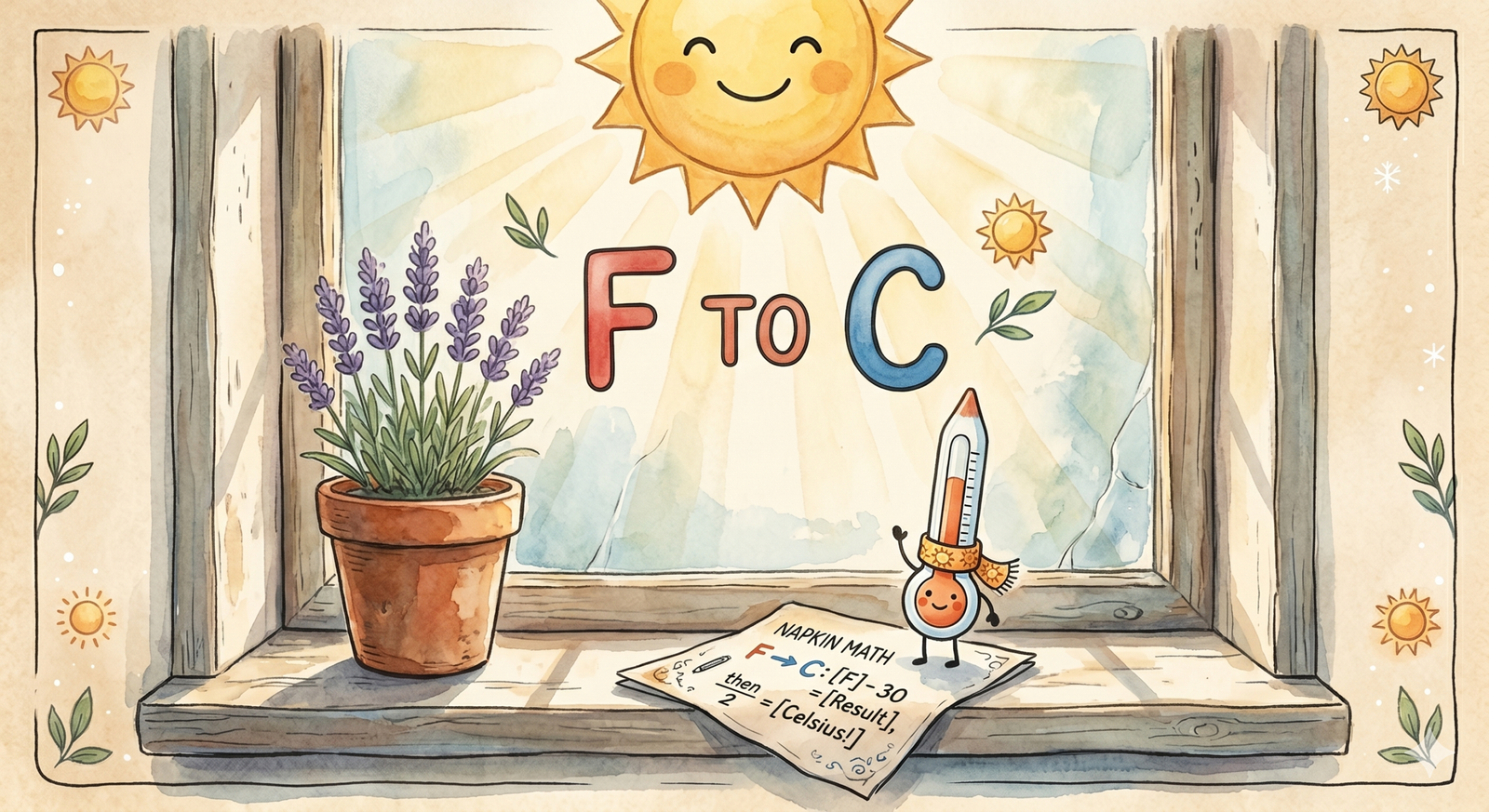
Subtract 30, then cut it in half.
Is it perfect? No. If it’s 80°F outside, the “napkin math” tells you it’s 25°C. The actual answer is about 26.6°C. You’re off by a degree and a half, but you’ve successfully decided that it is indeed “t-shirt weather.” For most of us, that’s a win.
The Landmarks of Temperature
The best way to stop constantly searching for a converter is to memorize the “anchor points.” These are the temperatures where the two systems shake hands and tell us exactly what’s going on.
-
The Freezing Point: 32°F is 0°C. This is the big one. If the number is lower than this, your plants are dying and your car needs scraping.
-
The “Room Temp” Sweet Spot: 68°F is 20°C. If you see 20 on a thermostat in Europe, you’re going to be perfectly comfortable.
-
The Fever Threshold: 100°F is roughly 38°C. If your body hits these numbers, it’s time for some Tylenol and a nap.
-
The Heatwave: 104°F is 40°C. This is the point where the air feels like a physical weight.
-
The 28/82 Coincidence: This is my favorite “human” trick. 28°C is almost exactly 82°F. It’s a perfect mirror that is surprisingly easy to remember when you’re on vacation.
The Minus 40 Meeting
There is one weird, lonely place where the “f to c” debate finally ends. At -40 degrees, it doesn’t matter which system you use. -40°F is exactly the same as -40°C.
It’s the point where the scales cross and everyone—Americans, Europeans, scientists, and polar bears—agrees on one thing: it is way too cold to be outside. There is something poetic about the fact that we only find total agreement when we are at the point of freezing our eyelashes off.
Why Fahrenheit Still Feels “Right” (To Some of Us)
Despite the logical superiority of Celsius, there is an argument to be made for the “f” in the “f to c” equation. Fahrenheit is remarkably granular. The difference between 70°F and 71°F is a subtle shift in the vibe of a room. In Celsius, that same jump is represented by a fraction.
Fahrenheit is the scale of the “felt experience.” When a weather reporter says it’s going to be in the 90s, there is a collective groan because we know exactly what that feels like. “The 30s” in Celsius just doesn’t have the same punchy, visceral weight for those of us raised on the Imperial system.
The Kitchen Conundrum
Perhaps the most dangerous place for an “f to c” error is the oven. If you’re following a British recipe and you see “200 degrees,” do not—I repeat, do not—set your American oven to 200. You will end up with a raw, soggy mess that has been “warmed” rather than baked.
On the flip side, if you put something in a Celsius oven at 350 degrees, you are essentially creating a small localized sun in your kitchen. You won’t have dinner; you’ll have a fire hazard. The 180°C / 350°F conversion is the golden rule of the culinary world. Master that one, and you’re halfway to being an international chef.
Embracing the Chaos
At the end of the day, the constant “f to c” conversion is just part of living in a globalized world. It’s a reminder that there are different ways to measure the same sun. Whether you’re checking the weather for a trip to Paris or trying to figure out if your laptop is overheating, these numbers are just symbols for how we interact with the world.
So, the next time you find yourself typing those three little letters into a search bar, don’t feel bad. You’re just participating in a centuries-old tug-of-war between human intuition and scientific logic. Just remember the “minus 30, half it” rule, and you’ll never find yourself wearing a sweater in a heatwave again.
And if you ever find yourself in -40 weather? Don’t bother checking the converter. Just get inside.
Quick Conversion Reference Table
| Fahrenheit (°F) | Celsius (°C) | The “Vibe” |
| 0°F | -18°C | Stay inside. Seriously. |
| 32°F | 0°C | Ice is forming; winter has arrived. |
| 50°F | 10°C | Light jacket, brisk walk. |
| 68°F | 20°C | The perfect room temperature. |
| 86°F | 30°C | Summer has officially started. |
| 100°F | 38°C | Finding a pool becomes the priority. |
Article Description
Whether you’re baking a cake or booking a flight, the struggle of converting “f to c” is real. We’re breaking down the mental math, the “82 is 28” trick, and why the world is still split between Fahrenheit’s human “vibes” and Celsius’s water-based logic. Stop the conversion headache and learn to “speak temperature” like a pro.
visit for more : trendlymora.com
