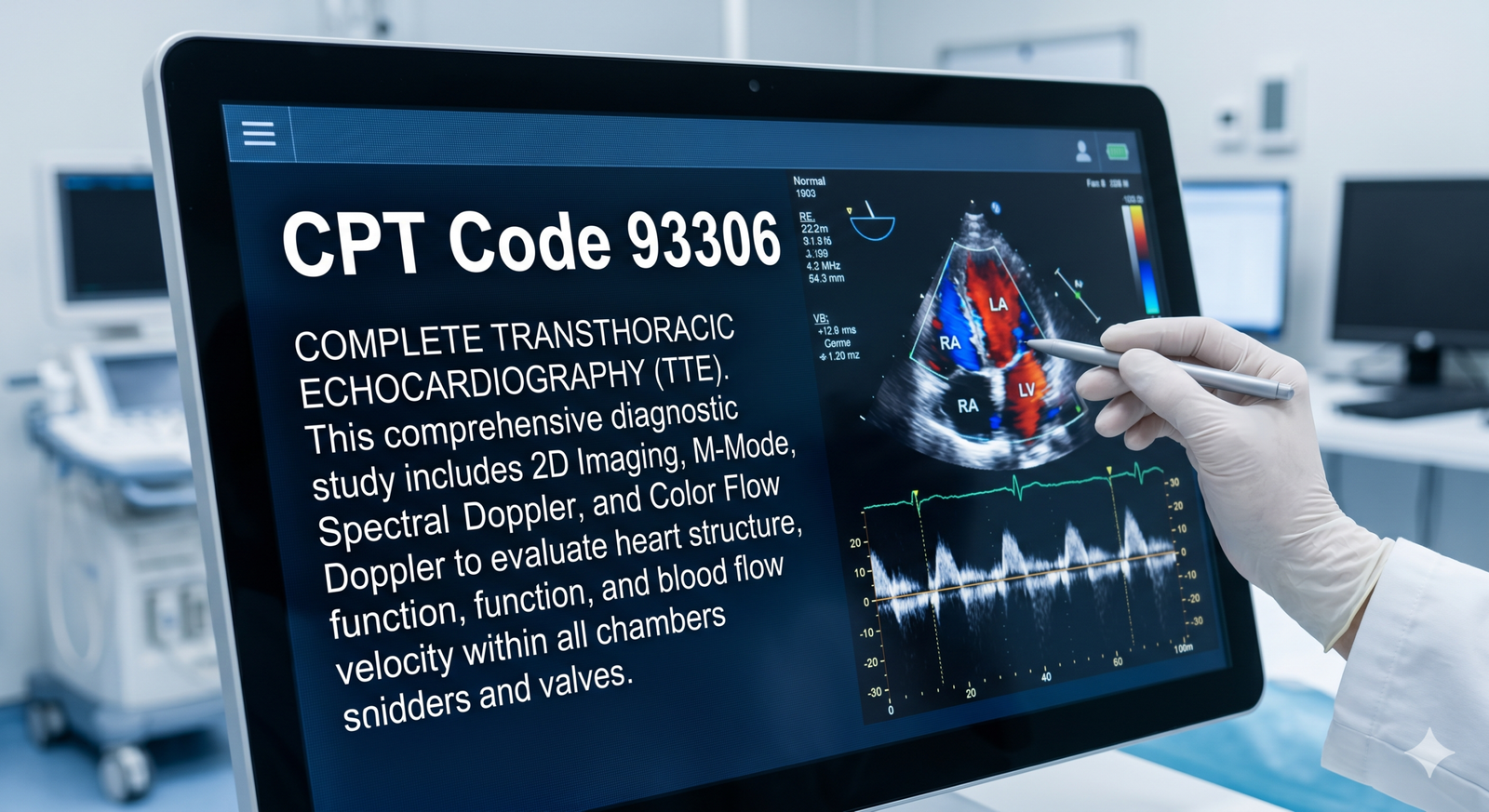
When it comes to diagnosing cardiovascular health, the Transthoracic Echocardiogram (TTE) is the gold standard for non-invasive imaging. In the complex world of medical billing and coding, this procedure is most commonly identified by CPT code 93306. Whether you are a patient trying to understand your recent medical bill or a healthcare professional ensuring coding accuracy, understanding the nuances of this specific code is vital.
CPT code 93306 represents a “complete” study, a cornerstone of diagnostic cardiology that provides a detailed roadmap of the heart’s structure and function.
What is CPT Code 93306?
According to the American Medical Association (AMA), CPT 93306 is formally defined as:
Echocardiography, transthoracic, real-time with image documentation (2D), includes M-mode recording, when performed, complete, with spectral Doppler echocardiography, and with color flow Doppler echocardiography.
In simpler terms, it is an ultrasound of the heart that combines three distinct technologies to give a full picture of how the heart is working. Unlike “limited” or “follow-up” studies, 93306 is exhaustive.
The Three Pillars of 93306
To qualify for this specific code, the procedure must include:
2D Imaging (and M-Mode): This provides the “movie” of the heart, showing the chambers, walls, and valves in motion.
Spectral Doppler: This measures the velocity and direction of blood flow through the heart’s valves and chambers.
Color Flow Doppler: This adds a color-coded map to the ultrasound, making it easier to see turbulence or leaks (regurgitation) in the valves.
When is CPT 93306 Ordered?
Physicians order a complete TTE for a variety of clinical reasons. Because it provides such a wealth of data, it is often the first line of defense when a patient presents with symptoms of heart distress.
Common Indications
Heart Murmurs: To determine if a murmur is “innocent” or caused by a structural valve problem.
Chest Pain and Shortness of Breath: To rule out heart failure or fluid around the heart (pericardial effusion).
Hypertension: To see if high blood pressure has caused the heart muscle to thicken (left ventricular hypertrophy).
Post-Stroke Evaluation: To check for blood clots in the heart that may have traveled to the brain.
Valvular Heart Disease: Monitoring the severity of stenosis (narrowing) or regurgitation (leaking).
The Procedure: What to Expect
For many patients, the term “cardiac procedure” can be intimidating. However, a 93306 study is entirely non-invasive and painless.
Step-by-Step Breakdown
Preparation: The patient removes clothing from the waist up and wears a gown. Electrodes are placed on the chest to monitor the heart rate (ECG) during the scan.
The Ultrasound Gel: A technician (sonographer) applies a cool gel to the chest. This gel acts as a conductor for the sound waves.
Imaging: The sonographer moves a transducer (wand) across various “windows” on the chest. They may ask the patient to breathe in, hold their breath, or roll onto their left side to get a clearer view of the apex of the heart.
Duration: A complete 93306 study typically takes between 30 to 60 minutes.
Coding and Documentation Requirements
For medical billers and coders, 93306 is a “bundled” code. This means it includes several components that cannot be billed separately if they are performed during the same session.
The Importance of “Complete”
To bill 93306, the medical report must document an evaluation of all the following:
Left and right ventricles.
Left and right atria.
Aortic, mitral, and tricuspid valves.
The pericardium (the sac surrounding the heart).
The adjacent aorta.
If any of these elements are missing from the documentation, and there is no clinical reason why they couldn’t be imaged, the coder may have to “downcode” to a 93307 (TTE without Doppler) or 93308 (limited TTE).
Technical vs. Professional Components
Like many imaging codes, 93306 can be split into two parts:
Modifier -TC (Technical Component): This covers the cost of the equipment, the room, and the sonographer’s time. This is usually billed by the hospital or imaging center.
Modifier -26 (Professional Component): This covers the cardiologist’s time and expertise in interpreting the images and writing the final report.
Common Myths and Misconceptions
“Does 93306 include a Stress Test?” No. A stress echo uses a different set of codes (93350/93351). 93306 is performed while the patient is at rest.
“Can I bill 93306 and 93320 together?” No. Code 93306 specifically includes spectral Doppler (93320) and color flow Doppler (93325). Attempting to bill them separately is considered “unbundling” and can lead to audits or claim denials.
“Is it the same as a TEE?” No. 93306 is a Transthoracic Echo (through the chest wall). A Transesophageal Echo (TEE), which involves swallowing a probe, uses code 93312.
The Value of 93306 in Modern Medicine
The data provided by a 93306 study is staggering. It allows doctors to calculate the Ejection Fraction (EF)—a critical percentage that indicates how well the heart is pumping blood. A normal EF is typically between 55% and 70%. If a 93306 reveals an EF of 35%, it provides immediate, actionable evidence of heart failure, allowing for life-saving interventions.
Furthermore, with the rise of preventative medicine, 93306 serves as a baseline. For patients undergoing chemotherapy (which can be toxic to the heart) or those with chronic conditions, having a “complete” study on file allows for precise comparisons over time.
Conclusion
CPT code 93306 is more than just a five-digit number on an insurance claim; it is a comprehensive diagnostic tool that provides a window into the most vital organ in the human body. By combining 2D imaging with advanced Doppler technology, it offers a level of detail that was unimaginable a few decades ago.
For patients, it offers peace of mind through a painless procedure. For providers, it offers the data necessary to make informed, life-saving decisions. Understanding the strict documentation requirements and the bundled nature of the code ensures that the healthcare system remains transparent and efficient, ultimately leading to better patient outcomes