



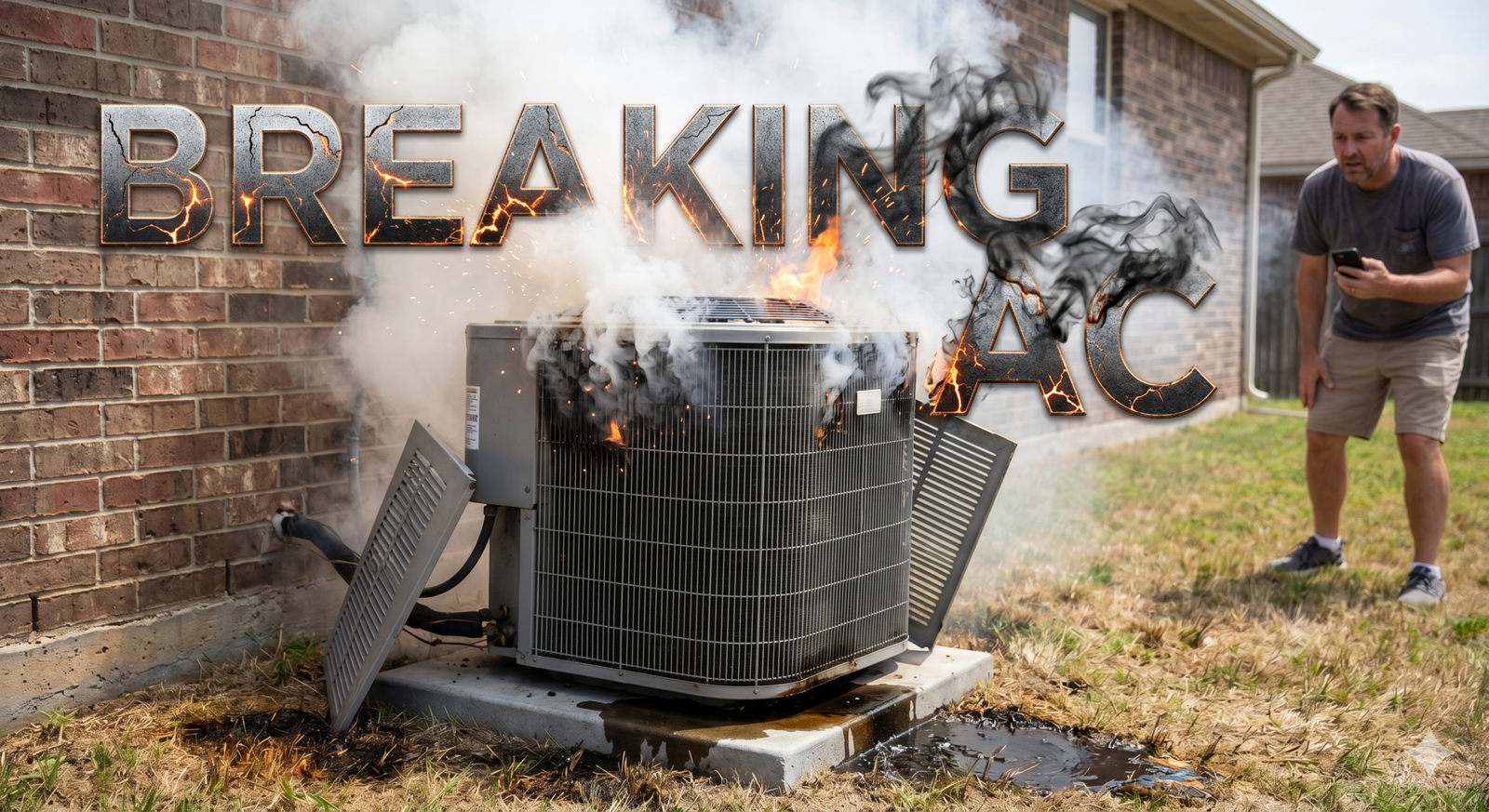
There is a very specific type of silence that occurs when an air conditioner stops working in the middle of July. It isn’t peaceful; it’s ominous. One minute, you’re enjoying a crisp 72-degree living room, and the next, you realize the gentle hum of the compressor has been replaced by a clicking sound, or worse, absolute stillness.
When we talk about a breaking AC, we aren’t usually talking about a clean snap. HVAC systems rarely just “die” instantly like a lightbulb. Instead, they go through a process of mechanical protest—a series of warning signs and performance dips that signal the end is near. Understanding why your unit is failing and how to respond can be the difference between a simple $150 capacitor swap and a $7,000 total system replacement.
The Warning Signs: Is Your AC Actually Breaking?
Before a unit completely gives up the ghost, it usually tries to tell you something is wrong. If you notice any of the following, your system is likely in the “breaking” phase.
The “Death Rattle” and Other Noises
Air conditioners should be relatively quiet. If yours begins to sound like a dryer full of loose change, take note.
Grinding: This usually points to motor bearings.
Squealing: Often a sign of a slipping or frayed fan belt.
Banging: This suggests something has come loose inside the compressor or the blower assembly.
Diminished Airflow
If you put your hand up to the vent and it feels like a tired puppy breathing on you, you have an airflow issue. This could be a failing motor, but it’s often a sign that your internal components are so clogged with dust or ice that air simply can’t get through.
The “Dirty Sock” Syndrome
If your AC starts emitting a musty, pungent odor, it’s not just a nuisance—it’s a sign of moisture buildup. This often happens when the condensate drain line is clogged, leading to standing water and mold growth inside the air handler.
The Usual Suspects: Why AC Units Fail
If your AC is breaking down, it usually boils down to one of four main culprits. Understanding these can help you communicate better with a technician (or save yourself a service call).
The Frozen Evaporator Coil
It sounds counterintuitive: how can something freeze when it’s 100 degrees outside? If your AC has restricted airflow (usually due to a filthy filter) or low refrigerant, the coil gets too cold. Humidity in the air settles on the coil and turns to ice. Once that happens, the ice acts as an insulator, and your AC will stop cooling entirely.
A Blown Capacitor
The capacitor is essentially a giant battery that gives your AC the “kick” it needs to start the motor. These are incredibly sensitive to heat. During a heatwave, capacitors are the #1 cause of AC failure. If you hear a humming sound coming from your outdoor unit but the fan isn’t spinning, your capacitor has likely “broken.”
Refrigerant Leaks
Your AC doesn’t “use up” refrigerant like a car uses gas. It’s a closed loop. If you are low on Freon or Puron, it means you have a leak. Continuing to run a unit with a leak will eventually burn out the compressor—the heart of the machine—which is a terminal diagnosis for most systems.
Clogged Condensate Lines
Your AC removes gallons of water from the air every day. That water goes into a drip pan and out a PVC pipe. If that pipe gets clogged with algae or sludge, the water backs up. Modern units have a “float switch” that will kill the power to the AC to prevent your house from flooding. It’s a safety feature, but it looks like a broken AC to the homeowner.
Troubleshooting: The “Before You Call” Checklist
Before you spend money on an emergency weekend service call, run through these three steps. You’d be surprised how often “breaking AC” is actually a “user error” situation.
Check the Thermostat: Is it in “Cool” mode? Are the batteries dead? Sometimes the simplest fix is the one we overlook.
Inspect the Air Filter: If you haven’t changed your filter in three months, your AC might just be suffocating. Swap it out, turn the system off for two hours to let any ice melt, and try again.
Check the Circuit Breaker: High heat causes high electrical demand. Your AC might have simply tripped the breaker. Flip it all the way to “Off” and then back to “On.”
The Repair vs. Replace Dilemma
When an AC is breaking down frequently, you have to do the math. HVAC professionals often use the “Rule of 5,000.” > Take the age of the equipment and multiply it by the repair estimate. If the number is more than $5,000, you should probably replace the unit.
For example, if your unit is 12 years old and the repair is $600 ($12 \times 600 = 7,200$), it is more economical in the long run to invest in a new, energy-efficient system. Modern units use significantly less electricity and come with warranties that protect you from the “breaking AC” cycle for at least a decade.
Prevention: How to Keep Your AC from Breaking
The best way to handle a broken AC is to ensure it never breaks in the first place. Maintenance isn’t just a marketing gimmick; it’s a mechanical necessity.
Annual Tune-Ups: A technician can spot a bulging capacitor or a small refrigerant leak in the spring before it becomes a total breakdown in August.
Keep the Outdoor Unit Clear: Your outdoor condenser needs to breathe. Keep grass, weeds, and “stuff” at least two feet away from the unit.
Level the Unit: If your outdoor pad has shifted and the unit is tilted, it can put undue stress on the refrigerant lines and the compressor oil levels.
Conclusion
Dealing with a breaking AC is never fun, but it doesn’t have to be a catastrophe. By staying ahead of the warning signs—listening for those odd noises and keeping your filters clean—you can extend the life of your system significantly.
If your system is currently blowing warm air or making a sound like a helicopter landing on your roof, turn it off immediately. Running a failing unit usually causes more damage. Call a pro, stay hydrated, and remember: even the best AC units have a shelf life. Sometimes, “breaking” is just the house’s way of telling you it’s time for an upgrade.
read also : From Dust to Divinity: The Ultimate Guide on How to Make Venus in Infinite Craft
Why is my AC blowing air that isn’t cold?
This is often caused by a dirty evaporator coil or low refrigerant levels. If the airflow is strong but warm, your compressor might not be engaging. First, check your thermostat settings to ensure it’s on “Auto” and “Cool,” not just “Fan.” If the settings are correct and the filter is clean, you likely have a refrigerant leak or a failed capacitor.
When should I turn off my AC immediately?
You must shut down the system if you notice:
Ice buildup on the copper lines or the indoor unit.
Screeching, grinding, or loud clanking noises (this indicates a mechanical failure).
A burning smell, which signals overheating wires or a motor on the verge of fire.
Rapid short-cycling, where the unit turns on and off every few minutes.
Can I keep running my AC if it’s leaking water?
If it’s leaking outside, that’s usually normal condensation. If water is pooling inside by your floor or ceiling, turn it off. This usually means your condensate drain line is clogged. Running it will only cause water damage to your home and could eventually short out the electrical components of the furnace or air handler.
Is a portable AC or a window unit a better “emergency” backup?
If you need a temporary fix while waiting for parts, a window unit is significantly more efficient and quieter because the compressor sits outside. However, if your windows are vertical-sliding or you live in an apartment with strict rules, a portable AC is the easier “plug-and-play” solution, though it will use about 30% more energy.
What information should I have ready for the repair technician?
To speed up the repair and lower your labor costs, have the following ready:
The Make and Model number (usually on a sticker on the side of the outdoor unit).
The approximate age of the unit.
A clear description of the “symptoms” (e.g., “It started hissing yesterday” or “The fan is spinning but the air is room temp”).
A clear, accessible path to both the indoor and outdoor units.
