



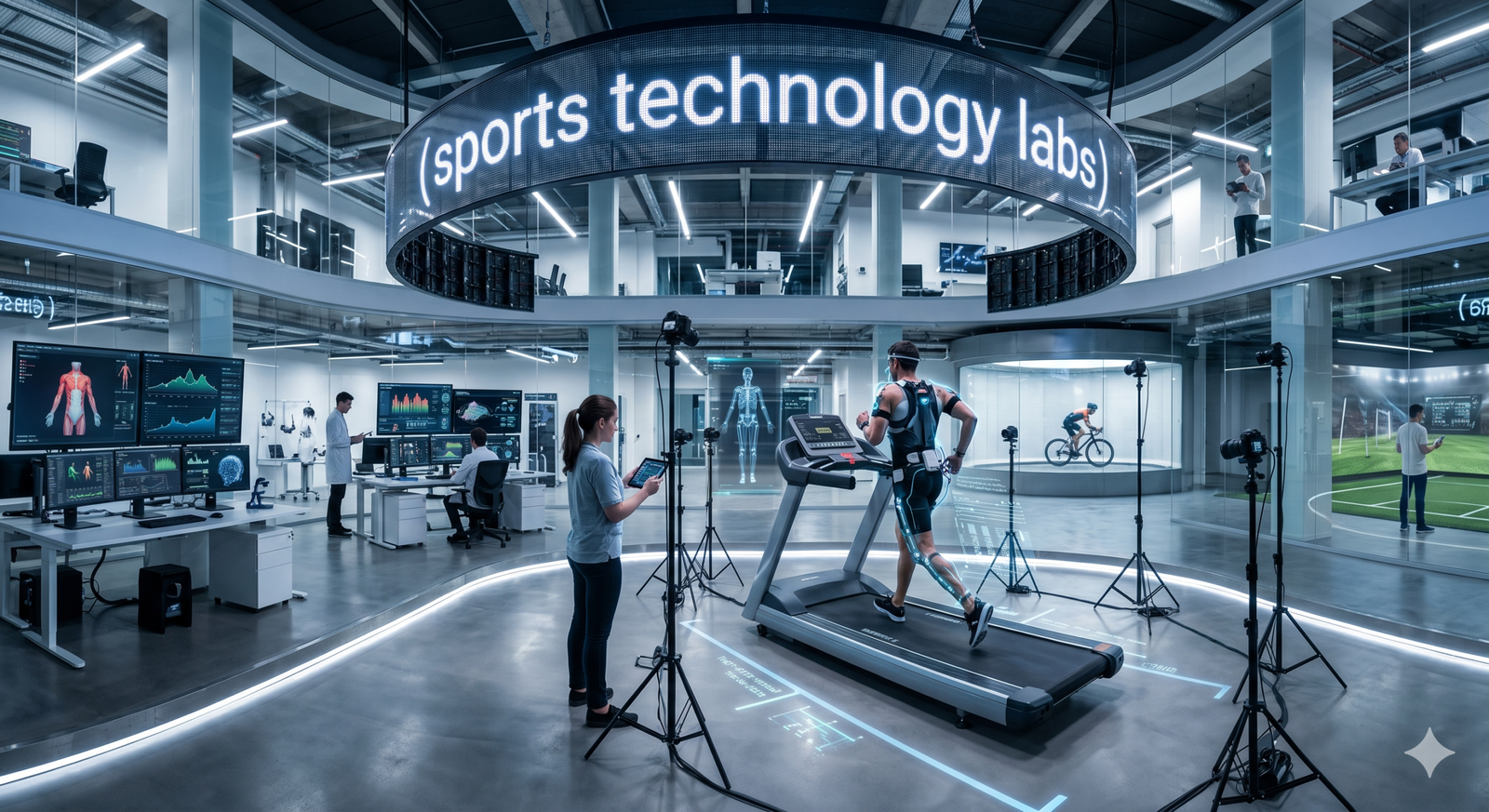
For decades, the image of an elite athlete was one of raw grit: a runner gasping for air on a dirt track, a boxer hitting a heavy bag in a dimly lit gym, or a swimmer pushing through “the wall” by sheer force of will. While heart and hustle still matter, the modern athlete is no longer just a physical specimen; they are a data point.
Welcome to the era of the Sports Technology Lab. These facilities—ranging from sleek university departments to secretive corporate R&D hubs—are the engine rooms of modern victory. They are where the margins of success are measured in milliseconds and millimeters, and where the limits of human biology are being systematically recalibrated.
What is a Sports Technology Lab?
At its core, a sports technology lab is a multidisciplinary environment where engineering, data science, physiology, and kinesiology converge. It isn’t just a gym with fancy gadgets; it’s a controlled environment designed to deconstruct athletic movement into its most basic components.
Whether the goal is to design a faster running shoe, prevent ACL tears, or shave a tenth of a second off a Formula 1 pit stop, these labs use high-fidelity sensors and software to provide answers that the naked eye simply cannot see.
The Pillars of Modern Athletic Innovation
To understand the impact of these labs, we have to look at the specific domains they influence. It isn’t just about “getting stronger”; it’s about getting smarter.
Avanced Biomechanics and Motion Capture
In a sports tech lab, you’ll often see athletes covered in reflective markers, performing their specific sport under the gaze of high-speed infrared cameras. This is optoelectronic motion capture. By digitizing a pitcher’s throw or a sprinter’s stride, researchers can create a 3D skeletal model to analyze joint torques and ground reaction forces.
For example, a lab might calculate the specific force $F$ exerted by a sprinter’s foot against a force plate using:
By understanding exactly how much power is lost to inefficient movement, coaches can suggest technical tweaks that prevent injury and maximize output.
Wearable Telemetry: Beyond the Smartwatch
While most of us use a smartwatch to track steps, sports technology labs are developing “invisible” wearables. These include smart textiles with conductive fibers that track muscle activation (EMG) and GPS trackers that monitor “player load” during high-intensity training.
The goal here is load management. By monitoring the physiological stress on an athlete in real-time, labs can predict when an athlete is entering the “red zone” of fatigue, allowing coaches to pull them back before a soft-tissue injury occurs.
The Science of Recovery
Innovation isn’t just about how hard you can train; it’s about how fast you can bounce back. Sports tech labs have pioneered technologies like:
Cryotherapy and Thermoregulation: Using extreme temperatures to manage inflammation.
Pneumatic Compression: Sleeves that use air pressure to mimic the body’s muscle pump, flushing out metabolic waste.
Neuro-priming: Using transcranial direct-current stimulation (tDCS) to “prime” the brain for faster skill acquisition and motor learning.
Data: The New “Performance Enhancer”
The most significant shift in these labs over the last five years has been the integration of Artificial Intelligence (AI). We are currently drowning in data, but data without insight is just noise.
Sports technology labs use machine learning algorithms to process thousands of hours of game footage and biometric data. These models can identify patterns that human scouts might miss—like a slight hitch in a player’s gait that precedes a hamstring strain, or a specific defensive alignment that high-probability scoring chances.
“The lab has turned the ‘gut feeling’ of the veteran coach into a verifiable, repeatable science. We are no longer guessing; we are measuring.”
The “Super Shoe” Phenomenon: A Case Study
Nothing illustrates the power of sports tech labs better than the recent revolution in distance running. For years, the marathon world record was stagnant. Then, labs began experimenting with carbon-fiber plates embedded in high-rebound PEBAX foam.
The result? The “Super Shoe.” These shoes act as mechanical springs, reducing the energetic cost of running by approximately 4%. This wasn’t just a win for the athletes; it was a triumph for the mechanical engineers and material scientists working behind the scenes in sports tech labs. It forced the governing bodies of sport to redefine what constitutes “fair” equipment—a debate that continues to rage today.
The Ethical Crossroads: Technological Doping?
As sports technology labs become more sophisticated, they raise uncomfortable questions. If a billionaire-backed team has access to a $10 million lab and their competitors don’t, is the playing field still level?
This is often referred to as “Technological Doping.” When the equipment or the data-driven training becomes more responsible for the win than the athlete’s natural talent, the “purity” of sport is challenged. However, proponents argue that technology simply allows athletes to reach their true potential by removing the obstacles of injury and inefficient training.
From the Lab to the Living Room
The best part of this innovation cycle is the “trickle-down” effect. The technology developed in elite labs today eventually finds its way to the weekend warrior.
The heart rate variability (HRV) tracking once reserved for Olympic cyclists is now on your finger via an Oura ring.
The percussive massage therapy (like Theragun) used by NFL players is now available at your local big-box retailer.
AI-driven coaching apps now provide personalized training plans that mirror the logic used by professional trainers.
Sports technology labs are essentially the “Concept Cars” of the human body. They test the extreme limits so that the rest of us can live healthier, more active lives.
Conclusion: The Human Element
Despite the sensors, the algorithms, and the carbon fiber, the most important variable in any sports technology lab remains the human spirit. A lab can provide the map, but the athlete still has to run the race.
Technology doesn’t replace the athlete; it illuminates them. It provides a mirror that shows us not just who we are, but what we are capable of becoming. As we look toward the future—to exoskeleton-assisted training, real-time blood glucose monitoring, and virtual reality playbooks—one thing is certain: the boundary between biology and technology will only continue to blur, and the records of today will be the warm-ups of tomorrow.
read also : The Definitive Guide to Swiss Chems: Purity, Research, and the Future of Biohacking
What is the primary goal of a Sports Technology Lab?
The primary objective is performance optimization and injury prevention. By collecting granular data on how an athlete moves, breathes, and recovers, labs can create a “bespoke” training program tailored to that individual’s unique biology. This shift from “one-size-fits-all” training to personalized data-driven protocols is what defines the new frontier of human potential.
How does AI play a role in these high-tech labs?
AI acts as the “brain” that synthesizes millions of data points. In 2026, predictive algorithms analyze an athlete’s sleep quality, heart rate variability (HRV), and training load to provide a daily “Readiness Score.” If the AI detects signs of overtraining or a slight change in a runner’s gait, it can alert coaches to reduce the intensity, preventing a season-ending injury.
Are these technologies available to amateur athletes?
While elite labs (like those used by Formula 1 or NBA teams) feature multi-million dollar equipment, the technology is rapidly “trickling down.” Consumer wearables and smartphone apps now utilize simplified versions of lab-grade algorithms. In 2026, many high-end commercial gyms offer 3D body scanning and basic biomechanical analysis that were exclusive to professionals just a few years ago.
What is “Neuro-Priming,” and why is it used in sports labs?
Neuro-priming involves using non-invasive electrical stimulation or specialized visual drills to put the brain into a state of “hyper-plasticity” before a workout. Labs use this to help athletes learn new techniques faster or to “warm up” the central nervous system, ensuring the brain is communicating with the muscles at peak efficiency from the first second of competition.
How do sports labs address the ethics of “Technological Doping”?
As technology evolves, the line between “training aid” and “unfair advantage” becomes blurred. Sports technology labs work closely with governing bodies to ensure that while they are pushing human potential, they aren’t violating the spirit of fair play. The focus is usually on optimizing natural biology rather than introducing external mechanical advantages that could be considered “technological doping.”
